Long before children learn to read the printed word, they learn to read the world.
They notice the warmth in a familiar voice. They recognize the rhythm of footsteps approaching down the hallway. They watch birds gathering twigs for their nests and marvel at the way rain gathers on a spider’s web. They live in pictures before they live in concepts.
Perhaps this is why stories have always been the first language of childhood.
Long before there were classrooms, worksheets, or even books, there were stories.
They were carried beside evening fires, whispered while kneading bread, sung during long walks through the fields, and passed from one generation to the next. Stories traveled wherever people traveled because they carried something more valuable than information.
They carried wisdom.
Today, we live in an age overflowing with information.
Children can ask a device almost any question and receive an answer in seconds. Facts are plentiful. Explanations are endless. Yet for all our access to knowledge, many of us sense that something essential is quietly slipping away.
Wonder.
The ability to sit with mystery.
The patience to let understanding unfold slowly.
The imagination to enter another world and return changed.
Stories protect these gifts.
A story never rushes to explain itself.
It offers an image instead.
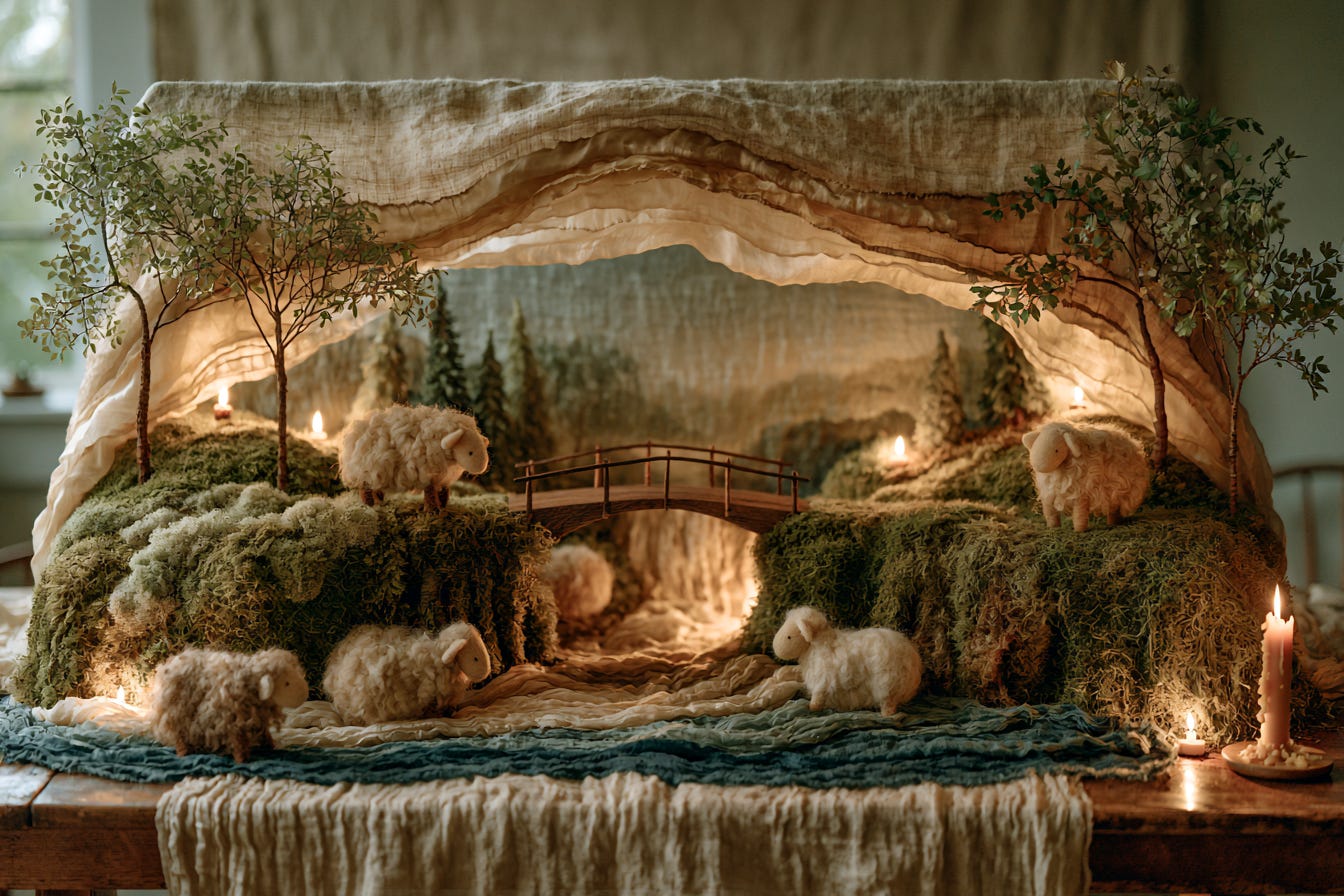
A bridge stretches across a rushing river.
A tiny seed sleeps beneath winter soil.
A shepherd watches faithfully through the night.
A child follows a trail of stars.
These images settle gently into the imagination, where they continue their quiet work long after the story has ended.
Children do not need every symbol explained.
In fact, they rarely ask for explanations.
They simply live with the images.
Days later, while building with blocks or wandering through the garden, the bridge appears again. The little seed begins to grow. The shepherd returns. The stars shine overhead.
The story has become part of their inner landscape.
This is one of childhood’s greatest gifts.
Young children do not separate learning from living.
A story is not merely heard.
It is inhabited.
It becomes the architecture of imagination, shaping how children encounter courage, kindness, generosity, patience, loss, hope, and joy.
This is why the oldest stories have endured.
Fairy tales.
Folktales.
Nature stories.
Legends.
These stories have traveled across centuries not because they entertain, but because they illuminate enduring truths about being human.
They remind us that every forest eventually opens into a clearing.
That kindness matters.
That courage often appears in ordinary clothing.
That transformation is possible.
That hope is worth carrying, even through the darkest woods.
Children do not analyze these truths.
They absorb them.
Not as lessons imposed from the outside, but as living possibilities growing quietly within.
Modern childhood, however, asks much of the imagination.
Screens arrive already filled with images.
Characters move before children have imagined them.
Stories are often explained before they have been experienced.
Entertainment becomes faster, louder, and more spectacular with each passing year.
Yet the human imagination has always flourished in spaciousness.
A simple woolen puppet becomes a bear.
A blue silk becomes a river.
A wooden block becomes a mountain.
An outstretched hand becomes a bridge.
When children are offered only finished pictures, there is little room left for them to create their own.
But when we leave gentle spaces—when we tell stories with simple words, offer handmade puppets instead of elaborate productions, or allow silence to linger between moments—we invite children to become co-creators.
Their imagination completes what we intentionally leave unfinished.
And in doing so, something extraordinary happens.
The story becomes theirs.
Perhaps this is why children ask to hear the same story again and again.
Adults often assume they are seeking familiarity.
In truth, they are continuing a conversation.
Each retelling reveals something new.
Each repetition deepens the picture.
Each return allows another layer of meaning to unfold, quietly and naturally, in its own time.
Stories are not consumed.
They are lived with.
That is why they matter now more than ever.
In a hurried world, stories teach us to linger.
In a noisy world, they invite us to listen.
In a distracted world, they gather our attention around something shared.
They remind us that wisdom cannot always be downloaded.
Sometimes it must be imagined.
Sometimes it must be felt.
Sometimes it must simply be carried in the heart until the day we are ready to understand it.
When we tell a child a story, we offer far more than words.
We offer companionship.
A place of belonging.
A language for courage.
A home for wonder.
And perhaps, without realizing it, we receive the very same gifts ourselves.
For stories are not only shaping our children.
They are quietly shaping us, too.
May we continue to tell them.
May we trust their ancient wisdom.
And may we never underestimate the quiet power of a well-loved story, lovingly told.
Continue the Journey
If this reflection resonated with you, I’d love to invite you to join our growing community at Waldorf Storytelling & Puppetry.
Each month, you’ll receive seasonal essays, original stories, Waldorf-inspired puppet plays, storytelling inspiration, handwork tutorials, nature table ideas, festival traditions, and thoughtful reflections designed to help you cultivate a childhood rooted in beauty, rhythm, and wonder.
Whether you’re a parent, grandparent, teacher, homeschooler, or caregiver, my hope is that this publication becomes a quiet companion throughout the seasons—a place to slow down, reconnect with the wisdom of childhood, and discover fresh inspiration for living the year with intention.
By subscribing, you’ll become part of a community that believes stories matter, beauty nourishes, and the simplest moments often become the memories children carry for a lifetime.
I would be honored to walk through the seasons with you.
Subscribe below and join us as we celebrate The Living Year™—one story, one season, and one beautiful moment at a time.
First published on the Waldorf Storytelling & Puppetry Substack.