Once upon a time.
Few words have traveled farther.
For centuries, these four simple words have opened the door to enchanted forests, humble cottages, talking animals, faithful helpers, hidden treasures, and impossible journeys. They have crossed oceans and generations, survived wars and changing cultures, and found their way into countless homes where children leaned just a little closer to listen.
In an age that often prizes novelty, it is remarkable that fairy tales continue to endure.
Why?
What is it about these ancient stories that still calls to us?
Perhaps it is because fairy tales were never meant to be merely entertaining.
They are not relics from a simpler time, nor are they quaint stories waiting to be replaced by newer ones.
They are part of humanity’s oldest wisdom tradition.
Long before psychologists gave names to developmental stages or researchers studied the power of narrative, communities understood that stories could carry truths too deep for explanation. They knew that the human heart often learns through images before it understands through words.
Fairy tales speak this language fluently.
They do not lecture.
They do not explain.
Instead, they invite us into a world where every path, every river, every mountain, and every encounter carries meaning without demanding interpretation.
A child meets a bridge guarded by a troll.
A shepherd tends the flock beneath the stars.
A tiny seed lies hidden beneath the earth until the right season arrives.
A forgotten kindness changes the course of an entire journey.
These are more than events in a story.
They are living pictures that quietly accompany children as they grow.
One of the remarkable qualities of fairy tales is their trust in the listener.
They never hurry to explain themselves.
The stories simply unfold, allowing each child to meet them according to their own stage of development.
A four-year-old may delight in the rhythm of repetition.
A seven-year-old may begin to recognize courage.
Years later, the same story may reveal an entirely different truth.
The tale has not changed.
The listener has.
This is one reason fairy tales remain lifelong companions.
They grow as we grow.
Modern culture often assumes that stories should be immediately understood.
We explain symbols.
We clarify meanings.
We summarize the lesson before allowing the experience to unfold.
Yet fairy tales offer a different kind of wisdom.
They trust mystery.
They allow questions to remain unanswered.
They leave space for the imagination to do its quiet work.
Children are remarkably comfortable with this.
Adults are often the ones who become uneasy.
We want to know what the forest represents.
What the wolf symbolizes.
Whether the dragon is fear, pride, or something else entirely.
Children rarely ask these questions.
To them, the forest is simply a forest.
The wolf is a wolf.
The dragon is a dragon.
And somehow, this is enough.
Their imagination receives the story whole.
Over time, the images settle gently into the inner life, becoming companions that continue to reveal new meaning without ever being forced.
This is one of the great gifts of fairy tales.
They honor the pace of human development.
They do not rush children toward adulthood.
Instead, they protect childhood’s unique way of knowing.
There is another reason these stories continue to matter.
Fairy tales remind us that goodness is often quiet.
The hero is rarely the strongest.
The youngest child succeeds through kindness rather than cleverness.
The faithful helper is often overlooked.
The smallest act of generosity becomes the turning point of the story.
Transformation comes not through domination, but through perseverance, humility, courage, and love.
These are not simply moral lessons.
They are patterns woven deeply into the human experience.
Children recognize them instinctively.
Perhaps this is why so many traditional tales begin in ordinary places.
A cottage.
A village.
A field.
A forest path.
The extraordinary enters quietly.
Magic does not replace the ordinary.
It reveals its hidden depth.
The same is true in childhood.
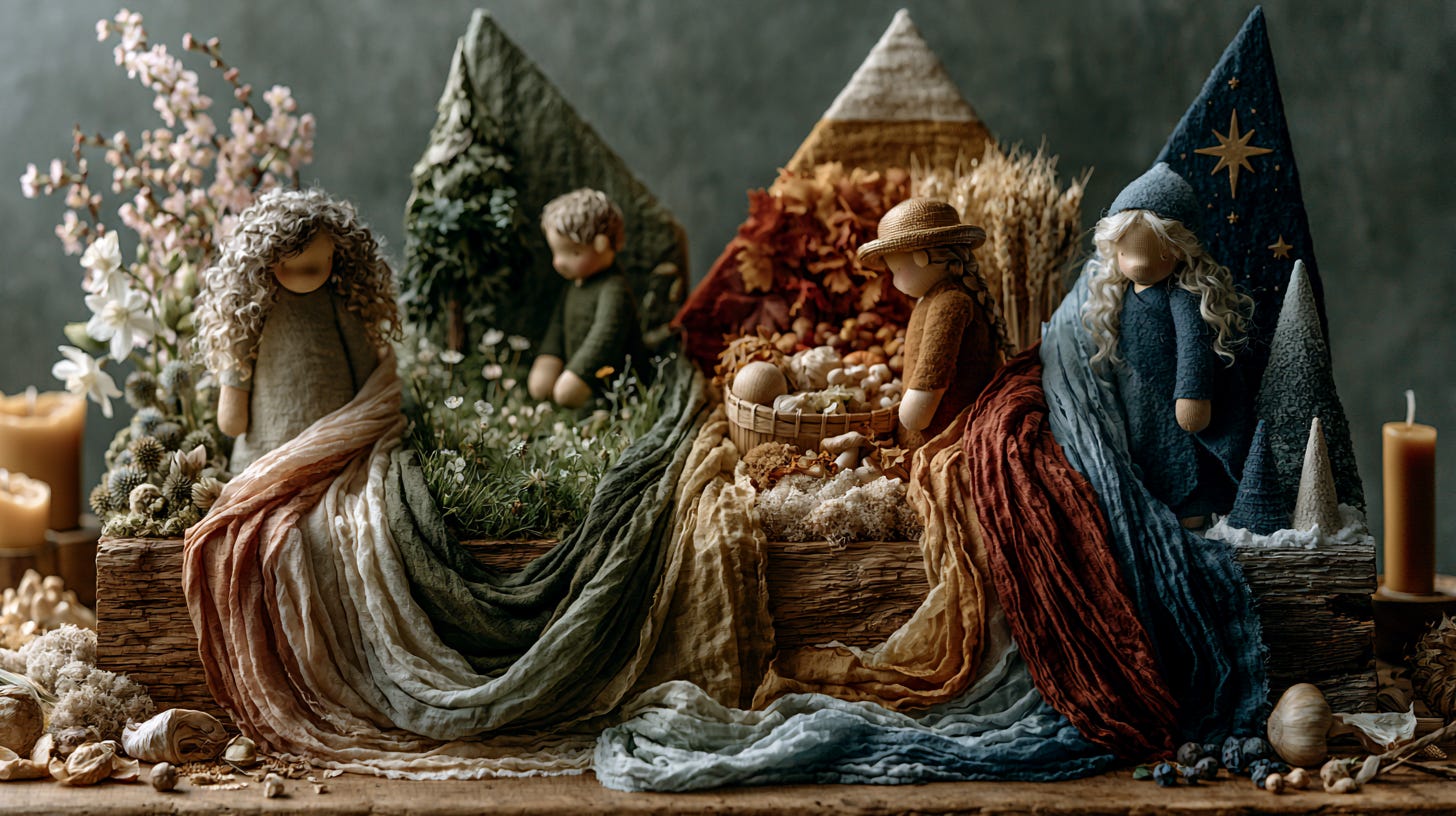
A basket of pinecones becomes treasure.
A woolen cloth becomes the sea.
A simple puppet becomes a beloved friend.
Children do not need elaborate worlds to experience wonder.
They need permission to imagine.
Fairy tales offer that permission.
They remind us that imagination is not an escape from reality.
It is one of the ways we come to know it more deeply.
In Waldorf education, fairy tales are treasured not because they belong to the past, but because they continue speaking to something timeless within every child.
They nourish the imagination before analysis.
They cultivate reverence before explanation.
They trust that wisdom grows slowly, like an acorn becoming an oak.
In a world eager to explain everything, fairy tales quietly remind us that some truths are better lived than defined.
Perhaps this is why we still gather children close and begin with those familiar words.
Once upon a time.
Not because the story happened long ago.
But because, somewhere deep within us, it is still happening now.
And every time we tell it with love, another child steps into its living wisdom.
May we continue to tell these old stories with fresh hearts.
May we trust their gentle work.
And may we remember that the greatest tales are never finished.
They continue unfolding in every generation that chooses to tell them once again.
Continue the Journey
If this reflection resonated with you, I’d love to invite you to join our growing community at Waldorf Storytelling & Puppetry.
Each month, you’ll receive seasonal essays, original stories, Waldorf-inspired puppet plays, storytelling inspiration, handwork tutorials, nature table ideas, festival traditions, and thoughtful reflections designed to help you cultivate a childhood rooted in beauty, rhythm, and wonder.
Whether you’re a parent, grandparent, teacher, homeschooler, or caregiver, my hope is that this publication becomes a quiet companion throughout the seasons—a place to slow down, reconnect with the wisdom of childhood, and discover fresh inspiration for living the year with intention.
By subscribing, you’ll become part of a community that believes stories matter, beauty nourishes, and the simplest moments often become the memories children carry for a lifetime.
I would be honored to walk through the seasons with you.
Subscribe below and join us as we celebrate The Living Year—one story, one season, and one beautiful moment at a time.
First published on the Waldorf Storytelling & Puppetry Substack.