There is something almost sacred about a small puppet stage.
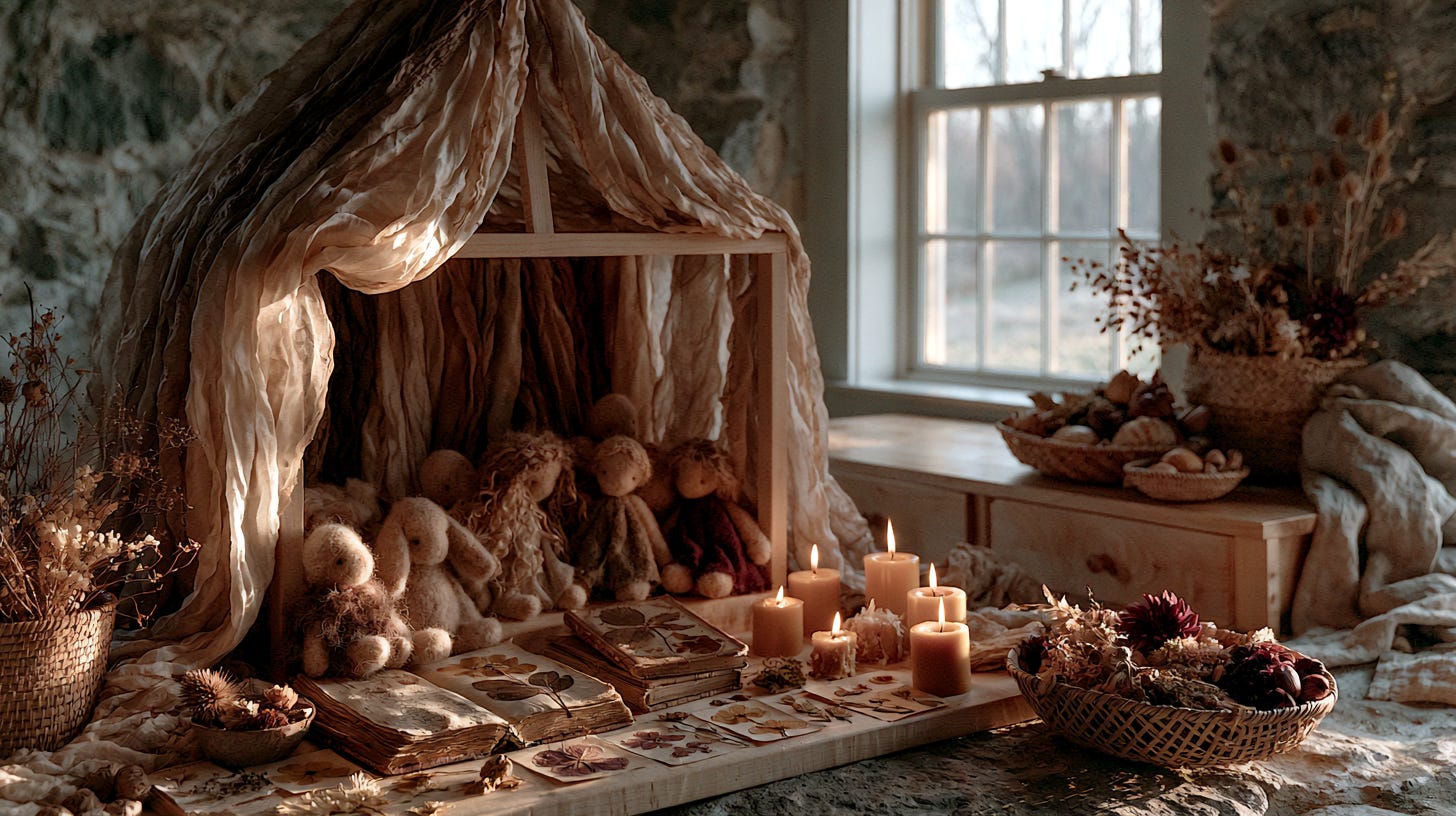
A length of silk draped over a simple wooden table.
A tiny woolen lamb waiting patiently beside a felt meadow.
A lantern glowing softly in the corner.
A quiet room filled with children who instinctively lean forward, not because something spectacular is about to happen, but because something gentle is about to unfold.
In many ways, a puppet play asks very little of us.
There are no elaborate sets.
No flashing lights.
No special effects.
Only simple materials, careful hands, and a story offered with love.
And yet, these humble performances often leave impressions that last for years.
Why?
Perhaps because puppet plays speak the language children know best.
The language of imagination.
Young children do not ask whether the puppet is realistic.
They do not question whether the river is truly flowing or whether the little sheep can actually walk.
A folded blue silk becomes a winding stream.
A branch becomes an ancient forest.
A woolen mouse becomes a trusted friend.
Children meet these images wholeheartedly because imagination is still their native language.
A puppet play does not attempt to convince children that something is real.
Instead, it gently invites them to participate in creating the world together.
This invitation is one of its greatest gifts.
Modern childhood is often surrounded by finished pictures.
Animated characters arrive fully formed.
Every detail is decided in advance.
Every movement choreographed.
Every expression predetermined.
There is very little left for the child to imagine.
A puppet play offers something different.
It leaves generous spaces.
The tree is only suggested.
The mountain is a folded cloth.
The stars are tiny points of light.
The audience quietly completes what has been intentionally left unfinished.
This act of participation nourishes the imagination in ways no finished image can.
Children become creators rather than consumers.
There is another quiet beauty hidden within puppet plays.
They move slowly.
A rabbit does not rush across the meadow.
The shepherd walks patiently toward the hillside.
The little red hen gathers her grain one careful step at a time.
Adults sometimes worry that this pace is too gentle.
Children rarely do.
Young children naturally inhabit a slower rhythm.
Their attention follows movement that feels purposeful rather than hurried.
A puppet lifting its head to greet the morning sun can hold an entire room in stillness.
Not because much is happening.
Because enough is happening.
The beauty of a puppet play is found not in excitement but in presence.
Perhaps this is why handmade puppets feel so different from manufactured toys.
Each stitch carries the care of the hands that made it.
Each felted sheep, little gnome, woodland mouse, or village baker possesses a quiet individuality.
They need not be perfect.
In fact, their very simplicity invites affection.
A child is not searching for perfection.
A child is searching for life.
Natural materials deepen this experience.
Soft wool.
Warm wood.
Flowing silk.
Smooth river stones.
A curved branch gathered on an autumn walk.
These materials already belong to the living world.
When they become part of a puppet play, they carry something of the forest, meadow, and mountain with them.
The stage itself becomes a little landscape of belonging.
Over time, puppet plays become woven into the rhythm of family and classroom life.
Certain stories return each season.
The Three Billy Goats Gruff crosses the bridge each autumn.
Star Money glows during the quiet weeks of winter.
Sweet Porridge bubbles gently in the spring.
Children come to recognize these stories not as performances, but as beloved companions marking the passage of the year.
The puppet stage becomes part of the seasonal rhythm, much like lighting a lantern, baking bread, or decorating a nature table.
It quietly says, The season has arrived.
Perhaps this is one reason puppet plays remain so meaningful.
They gather people together.
Not around a screen.
Not around noise.
But around a shared experience.
The storyteller slows.
The audience settles.
The room grows quiet.
For a few precious moments, everyone is looking in the same direction.
In a world where our attention is so often divided, this simple act of shared presence feels increasingly rare.
And increasingly necessary.
Puppet plays also remind us of something easily forgotten.
Children do not need more stimulation.
They need more beauty.
They do not need larger spectacles.
They need deeper experiences.
A single candle glowing beside a tiny woolen shepherd can awaken more wonder than the grandest production if it is offered with sincerity.
Beauty does not have to announce itself.
It simply has to be present.
Perhaps that is the quiet wisdom of the puppet stage.
It teaches us that the smallest things are often enough.
A piece of blue silk.
A handful of moss.
A tiny felted bird.
A gentle voice.
A story lovingly told.
Together, they become something far greater than their individual parts.
They become a memory.
A tradition.
A place where imagination is welcomed and childhood is honored.
May we continue to gather around these little stages.
May we keep stitching tiny companions from wool, arranging silks into rivers and hills, and telling stories that have been carried across generations.
For every time we do, we create more than a puppet play.
We create a moment of shared wonder.
And sometimes, those quiet moments become the stories children remember long after childhood itself has passed.
Continue the Journey
If this reflection resonated with you, I’d love to invite you to join our growing community at Waldorf Storytelling & Puppetry.
Each month, you’ll receive seasonal essays, original stories, Waldorf-inspired puppet plays, storytelling inspiration, handwork tutorials, nature table ideas, festival traditions, and thoughtful reflections designed to help you cultivate a childhood rooted in beauty, rhythm, and wonder.
Whether you’re a parent, grandparent, teacher, homeschooler, or caregiver, my hope is that this publication becomes a quiet companion throughout the seasons—a place to slow down, reconnect with the wisdom of childhood, and discover fresh inspiration for living the year with intention.
By subscribing, you’ll become part of a community that believes stories matter, beauty nourishes, and the simplest moments often become the memories children carry for a lifetime.
I would be honored to walk through the seasons with you.
Subscribe below and join us as we celebrate The Living Year—one story, one season, and one beautiful moment at a time.
First published on the Waldorf Storytelling & Puppetry Substack.